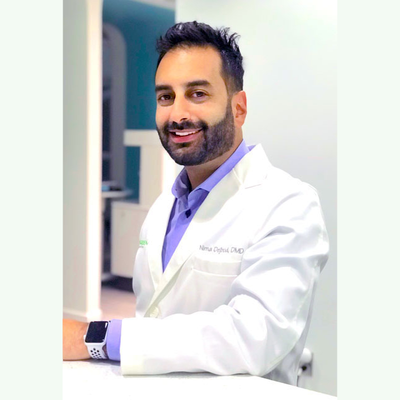
Tacoma's Root Canal Experts for Teeth Others Gave Up On
Some teeth need a second opinion with a microscope behind it. Tacoma patients make the 45–55 minute run up I-5 and SR-18 for retreatments, cracked molars, and the cases general offices refer out — the exact work Dr. Nima Dejbod does all day, every day.
Seattle Met Top Dentist 2026VP, WA State Assoc. of EndodontistsAAE MemberNot Corporate-Owned
Molar just crack?
Bite down wrong in the North End and you know it instantly. Emergency appointments are held back every business day — call early, take I-5 north to SR-18 east, and you can be numb before lunch.
Untreated decay, a failing old filling, or a crack from years of hard chewing lets bacteria slip into the pulp chamber. The tissue inside gets infected, and pressure with nowhere to go becomes pain you can't ignore.
02
The repair
Guided by a surgical microscope, Dr. Dejbod takes out the infected tissue, flushes and disinfects the full length of every canal, and seals the system shut against new bacteria.
03
The payoff
The tooth stays. The pain leaves. Your Tacoma dentist adds a protective crown, and you chew on that side again without thinking about it.
Specialist vs. Generalist
Why Tacoma Dentists Send Their Hardest Cases North
Plenty of offices start root canals. Far fewer finish the difficult ones well. The honest comparison:
Evergreen Endodontics
Typical General Office
Training
A two-to-three-year endodontic residency after dental school, devoted solely to the inside of teeth
One dental degree covering dozens of procedure types, root canals among them
Volume
10,000+ root canals completed — including the retreatments and cracked molars others refer away
A handful of root canals per month, slotted between hygiene checks and crown preps
Magnification
Surgical microscope at up to 14x on every case — the missed canal from a first attempt gets found
Loupes or naked eye; the canal that was missed once can be missed again
Sedation
Nitrous, oral, and IV sedation available in-house, matched to your anxiety level
Varies widely; IV sedation is uncommon in general practice
Your Visit
Your Appointment, Mapped Out
About an hour in the chair — then the drive home feels a whole lot better than the drive up.
1
Look & Measure
Focused testing, digital X-rays, and a 3D CBCT scan when the roots hide something — you watch the findings on screen with us.
2
Straight Talk & Price
What's wrong, whether the tooth is worth saving, and the exact cost — all settled before any instrument touches the tooth.
3
Numb & Fix
Thorough anesthesia, microscope-guided cleaning and sealing, sedation if you'd like it. Most Tacoma patients head back down SR-18 within about an hour.
Comfort Menu
Nervous? There's a Level for That
Tough town or not, dental fear is universal. Three settings, your call:
Option
How It Feels
Best For
Nitrous Oxide
A gentle, floaty calm that clears minutes after the mask comes off — drive yourself home
Mild jitters, straightforward cases
Oral Sedation
A pill taken before arrival; profoundly relaxed, and the details of the visit fade fast
Moderate anxiety, retreatments, long appointments
IV Sedation
Deep conscious sedation adjusted in real time — patients consistently call it a short nap
Severe fear, surgical cases, strong gag reflexes
The Instrument Room
Built to Find What Was Missed
A failed root canal usually means something was overlooked. Our equipment exists to make sure it isn't overlooked twice:
◆
Surgical Microscope
Up to 14x magnification exposes extra canals, fractures, and old obstructions that loupes simply can't resolve.
◆
3D CBCT Imaging
A full volumetric scan shows why the first treatment failed before we ever reopen the tooth.
◆
Digital X-Rays
Instant, low-radiation images reviewed chairside — no film, no darkroom, no delay.
◆
Apex Locator
Pinpoints the exact end of each root electronically, so cleaning reaches the very tip.
Patient Voices
Word Travels From the Chair
Three favorites from a wall of 400+ five-star reviews.
★★★★★
“
My dentist thought the tooth might not be savable. Dr. Dejbod found the hidden canal under the microscope and saved it.
— Priya K., Kirkland
Complex case
★★★★★
“
NO pain or discomfort during or after the procedure.
— David W., Issaquah
Pain-free experience
★★★★★
“
IV sedation made the whole thing feel like a ten-minute nap. I was back at work the next morning.
— Elena S., Seattle
IV sedation
Second opinions, every single day
Tacoma's Retreatment Specialist
“Retreatment is some of my favorite work. A tooth that failed once usually failed for a findable reason — a missed canal, a hidden fracture. Under the microscope, those reasons stop hiding. When I can hand a Tacoma patient their own tooth back, that's a good day.”
Dr. Nima Dejbod, DMD · Washington State native · UW graduate · Seattle Met Top Dentist 2026 · Vice President, WA State Association of Endodontists
Insurance carriers set identical in-network fees at every in-network office, so price shopping changes nothing — skill shopping changes everything. With benefits remaining, most insured patients owe $160–$655 out of pocket.
We work constantly with plans from MultiCare, UW Tacoma, the Port of Tacoma, and JBLM-area employers — benefits confirmed before treatment, never after.
Getting Here
Tacoma to Issaquah: 45–55 Minutes, Door to Door
The route Tacoma patients know well: I-5 north to SR-18 east at Federal Way, through Auburn, then Issaquah-Hobart Road to 600 NW Gilman Blvd. From the North End, Proctor, or University Place it's still under an hour — and when a tooth's survival is the question, under an hour is nothing. Lakewood and Fife patients ride the same corridor. Free parking waits right at the building.
From the North End to Lakewood, University Place to Fife, South Sound patients reach specialist care in under an hour via I-5 and SR-18. Find your neighborhood below — if it's listed, you're covered.
Plan on 45 to 55 minutes: I-5 north to SR-18 east at Federal Way, then across Auburn to Issaquah-Hobart Road. From the North End or University Place it runs toward the longer end; from Fife or the east side it can be quicker.
Why do Tacoma dentists refer retreatments to you?
Because retreatment is microscope work. A tooth whose first root canal failed usually failed for a findable reason — a missed canal, a crack, a leaking seal. Dr. Dejbod has completed 10,000+ root canals and does nothing else, so the anatomy that hid the first time does not stay hidden.
Do you see patients from the North End, University Place, and Lakewood?
Every week. North End, Proctor, University Place, Lakewood, and Fircrest patients all funnel onto the same I-5 to SR-18 corridor and reach our Gilman Boulevard office in under an hour — with free parking waiting at the door.
Will my MultiCare, UW Tacoma, or JBLM-area dental plan work?
Very likely. We are in-network with the major PPO plans carried by MultiCare, UW Tacoma, the Port of Tacoma, and most JBLM-area employers. Coverage is verified before your visit, so there are no billing surprises.
What does a root canal cost with insurance?
In-network contracted rates are roughly $800 for a front tooth, $1,000 for a premolar, and $1,300 for a molar. With benefits remaining, most insured patients pay $160–$655 out of pocket — a number you see and approve first.
My first root canal failed — what does retreatment actually involve?
Dr. Dejbod reopens the tooth, removes the old filling material, finds what was missed the first time — often an extra or calcified canal — disinfects everything, and reseals. Most retreatments finish in a single visit of about 90 minutes, and you get an honest prognosis before committing.
For Referring Dentists
Refer Your Patient to Dr. Dejbod
For the Tacoma cases other offices could not save, we deliver microscope-guided retreatment and a complete same-day report to your office.
Medically reviewed by Dr. Nima Dejbod, DMD, endodontist and Vice President of the Washington State Association of Endodontists. About Dr. Dejbod
Last medically reviewed:
This content is for informational purposes only and is not a substitute for professional medical advice, diagnosis, or treatment. Always consult your dentist, physician, or another qualified health provider with any questions about a dental condition.